Pakistan, An Extraordinary Example of Peace Leadership

By: Raza Shah Khan, IPB Board Member

At a time when the world is increasingly fractured by geopolitical rivalries and hardened national positions, the recent tensions between the United States and Iran served as a stark reminder of how quickly crises can spiral into catastrophic conflict. In such moments, the true cost of war is not measured in strategic gains or losses, but in human suffering — borne disproportionately by ordinary citizens.

For a region already burdened by instability, a direct confrontation between the United States and Iran would have had far-reaching consequences. Beyond the immediate theatre of conflict, the ripple effects would likely have included economic disruption, particularly through energy markets, and increased insecurity across the globe. Yet, the gravest impact would have been humanitarian. Civilians — as seen repeatedly in conflicts across Iraq, Syria, and Yemen — inevitably bear the brunt of war: displacement, loss of livelihoods, and the erosion of already fragile public services.

In this fraught context, Pakistan’s diplomatic engagement to facilitate dialogue between Tehran and Washington reflects the kind of leadership that is too often missing in today’s international system. At a time when major powers remain entrenched in positions of confrontation, the willingness to prioritize de-escalation and dialogue is both necessary and commendable.

Maintaining working relationships with both Iran and the United States, Islamabad is uniquely positioned to act as a bridge in moments of crisis. Its engagement underscores an important principle: that even in deeply polarized environments, channels for communication must remain open. Dialogue, however difficult, is always preferable to escalation.

The significance of such efforts extends beyond a single crisis. In an interconnected world, conflicts are no longer contained within borders. Economic shocks reverberate globally, humanitarian crises strain international systems, and insecurity spreads across regions. The consequences of war are shared — but so too must be the responsibility to prevent it.

What is urgently needed today is a renewed commitment to what may be termed “peace leadership.” This requires states to move beyond reactive diplomacy and invest in sustained efforts to build trust, reduce tensions, and prevent conflicts before they erupt. It calls for political courage — the willingness to engage adversaries, absorb criticism, and prioritize long-term stability over short-term gains.

Pakistan’s role in the recent crisis offers a reminder that such leadership is both possible and necessary. It demonstrates that diplomacy, when pursued with intent and clarity, can serve as a powerful tool for stability in an otherwise volatile world.

The lessons are clear. The world cannot afford another protracted conflict in an already fragile region. Nor can it continue to rely solely on power politics to resolve disputes that demand dialogue and compromise.

Peace is not self-sustaining. It requires deliberate effort, sustained engagement, and leadership that is willing to place humanity above hostility.

In an age defined by division, the real test of leadership is not the ability to wage war, but the resolve to prevent it. The choice before the international community is stark: continue down a path of confrontation, or invest in the hard, necessary work of peace.

The cost of getting this wrong will not be measured in policy failures, but in human lives. And that is a price the world can no longer afford to pay.

Disclaimer: This article was originally written by the author(s). The views expressed do not necessarily represent the official position of the International Peace Bureau.

Iran’s Resilience, US’s Hubris, Israel’s Malevolence

Author: Anuradha Chenoy, IPB Board Member

The fragile ceasefire can hold only if Israel is restrained and ceases its aggression against Lebanon.

A two-week ceasefire and negotiations announced on 8 April, after six weeks of the illegal war by the United States (US) and Israel on Iran, and President Donald Trump’s threats of a genocide on “a civilisation,” remain fragile as its terms are already in dispute. Iran’s 10-point proposal includes a ceasefire in Lebanon. Israel disputes this and continues to bomb Lebanon. Trump is presenting different versions. The Islamic Revolutionary Guard Corps (IRGC) has declared that if Israeli attacks on Lebanon do not stop, then Iran will respond. In this context, negotiations between the sides will be challenging since the demands of the sides appear incompatible. Israel will be a spoiler. So, the truce remains fragile. 

The US’s reasons for the war on Iran included regime change, destruction of Iran’s missile production, seizure of enriched uranium, even though Trump claimed to have destroyed this during the June 2025 bombing of Iran. The US objective in the Gulf is to provide security for Israel and the Gulf and project US primacy. In this war, US bases across Gulf countries have been hit and damaged. The US spent $1 billion a day and has not been able to provide security for its Gulf allies. European allies did not support this war and maintained neutrality. US objectives have not been met, and the war exposed the limits of US power and hegemony.

Israel’s objective in this phase of its permanent war is to occupy South Lebanon, as finance minister Bezalel Smotrich called for Israel to extend its border to the Litani River—deep inside Lebanon’s south (Times of Israel, 23 March 2026). For Israel, this war is the continuation of its genocidal war against the Palestinian people and expanding its borders into Syria and Lebanon. To achieve this, Israel has to destabilise Iran and the “Axis of Resistance,” which comprises Iran’s non-state allies. 

Israel’s objectives remain unmet and so it continues bombing Lebanon after the ceasefire. It has ordered ethnic cleansing and one million are displaced from South Lebanon. Hezbollah, the militia that had removed Israel from its occupation of South Lebanon in 2000, continues to resist Israeli attacks. Israel, however, needs the support of the US to continue this war. Right now, the US does not seem to have an appetite to restart the war on behalf of Israel, as US citizens largely oppose the war and Trump is facing declining popularity numbers. 

For Iran, this war is about regime survival, which it has achieved at a high cost of lives and infrastructure destruction. The ceasefire in Lebanon is linked with Iran’s ceasefire proposal. The Iranian 10-point proposal for negotiations includes non-aggression, continued Iranian control over the Strait of Hormuz (to be shared with Oman), acceptance of enrichment, lifting of all sanctions, compensation to Iran, and withdrawal of US forces from the region. The Iranian foreign minister specifically said that this temporary truce does not signify the termination of the war.

The war so far shows Iran’s resilience. Despite the killing of its top leadership, over 2,000 citizens killed, and battered infrastructure, Iran retaliated regionally across seven countries and showcased its resistance. The Iranian regime did not fall and Iran retains its capabilities. 

The reasons for such resilience lie in the nature of the Iranian state, embedded in its history and culture. Iran is a state in resistance. Its core, the IRGC, is tied with the clergy headed by the Ayatollahs, while the Iranian elected parliament coordinates with the two. The US killing Ali Khamenei in his home, not in an underground bunker, symbolised Shiite martyrdom, which is not lost on the Iranian public who remain mobilised behind the state. His son and successor, Mojtaba Hosseini Khamenei, served in the IRGC, in the Iran–Iraq war, worked in his father’s office and is closely connected to the IRGC. 

The popular 1979 Iranian revolution designed the IRGC as special forces to protect the Islamic Republic and the principles of the revolution. The IRGC is a layered structure with multiple capabilities across Iran’s 31 provinces and is integral to the functioning of the system. It is decentralised, adapted to local environments and operates in low-intensity conflicts with specialised subgroups like the Quds (overseas) force, the Basij (internal security) and the Iranian navy. This is the “mosaic” system, where the IRGC functions as modern guerrilla warfare to counter external intervention. 

Iran blocked the narrow Strait of Hormuz as leverage. Twenty percent of global oil, besides fertilisers and other resources, passes through it. Oil prices escalated ($120 at peak) and threatened global recession. Iran was able to sustain the war since 90% of its food requirements are local. While the Gulf states depend on desalination plants for 70%–100% of their drinking water, Iran relies on traditional water sources and only 3% on desalination. Forty-seven years of US sanctions have made Iran self-reliant where basic needs are locally manufactured. Iran was kept out of globalisation and has no active International Monetary Fund loan or outstanding debt. Iran’s borrowings are from oil revenues and bilateral deals with Russia and China. US Treasury Secretary Scott Bessent stated that Washington engineered a dollar shortage in Iran, causing the rial’s freefall that provoked the January protests (Al Jazeera, 13 February 2026) to attain quick regime change after the decapitation of the leadership. This plan failed. 

Iran developed strategic depth over the years by building a network with non-state informal resistance groups (militia) across the region, which include Hamas (Palestine), Hezbollah (Lebanon), Iraqi Shia militias, the Houthis in Yemen and, earlier, the Syrian Assad regime that fell. These are indigenous and autonomous groups and they coordinate with Iranian special forces. They joined the war with Iran. Hezbollah attacked Israel, Iraqi militia attacked US bases, and the Houthis of Yemen committed to support Iran by targeting the key strait of Bab-el-Mandeb on the Red Sea to block shipping lines of the Suez Canal. 

Trump has demanded an open and free passage in the Strait of Hormuz, Iran give up its enriched uranium, stop long-range missile production, and break its contacts with its non-state allies in the region. Iran had earlier rejected these proposals. If the US–Israel insist on these, the ceasefire cannot hold. There is far too much at stake for Iran, as it cannot betray its regional ally, Hezbollah. Iran has been betrayed by the US several times, as they bombed Iran while the talks were ongoing twice before, besides tearing up the United Nations Security Council ratified Joint Comprehensive Plan of Action curbing Iran’s nuclear enrichment. 

The international community has a stake in ending this war since the costs are high globally. The US is in this war to preserve its hegemony and control over oil and oil routes, which give it a leverage over China and Asia, maintain Gulf monarchies and the petrodollar. Israel is in a war for its dream of a greater Israel. Iran is defending its nationhood, existence, and people, and in doing so, defending a multipolar international system. 

The sane world of laws, civility, and respect for civilisation, invested in human security hopes for an end to this war without further damage and hurt. However, there is yet no cause for celebration. The US is not likely to agree to most of Iran’s demands. Israel will play spoiler, continuing the war to gain territory from Lebanon and Syria. Iran cannot give in without fulfilling several of its demands. The ceasefire will hold only if Israel is restrained. The ceasefire and negotiations will require extraordinary will from the sides involved. 

Disclaimer: This article was originally written by the author(s). The views expressed do not necessarily represent the official position of the International Peace Bureau.

This article is also published in the Economic and Political Weekly.
Global Solidarity for Peace in Palestine Coalition Rejects the Expansion of the Death Penalty in Israel

March 31, 2026 | By: Global Solidarity for Peace in Palestine Coalition (GSPP)

*The International Peace Bureau is a member of the GSPP.

The Global Solidarity for Peace in Palestine Coalition of over 100 organizations across four continents expresses grave concern regarding legislative and political efforts within the Knesset and the Government of Israel to expand the use of the death penalty for individuals convicted of murder or acts defined as terrorism.

We call on Israeli authorities to reject  and or repeal any legislation that  broadens the use of capital punishment. Such a measure would represent a serious violation of the global movement toward abolition and would undermine fundamental human rights protections, particularly the right to life.

Continue reading “Global Solidarity for Peace in Palestine Coalition Rejects the Expansion of the Death Penalty in Israel”

The underlying issue: Nuclear weapons and their proliferation & Letter for nuclear non-proliferation in Germany

The underlying issue: Nuclear weapons and their proliferation

By Pablo Ruiz*

The fundamental question is not up for debate: Should countries possess nuclear weapons? There are nine nuclear powers. In the current landscape, France will expand its nuclear arsenal; the Finnish government is set to introduce a bill to allow the country to acquire them; and Germany already has the capability to produce them whenever it chooses.

While the world follows the Israeli-American war against Iran through the media, and while it is repeatedly argued that the aim is to curb Iran’s nuclear program, these governments, the press, and the international community continue to ignore the fundamental issue—and the paradox—that both the US and Israel do possess nuclear weapons, also known as weapons of mass destruction. China, Russia, Pakistan, France, the UK, India, and North Korea are also part of this select group of nuclear powers.

Continue reading “The underlying issue: Nuclear weapons and their proliferation & Letter for nuclear non-proliferation in Germany”

Joint Press Release – Human Rights Organisations Express Concern Over the Immediate Risk of Deportation of Russian War Resister Maksim Kuzmin to the Russian Federation

The undersigned organisations express their serious concern regarding the immediate risk of deportation of Maksim Kuzmin back to Russia, as he is approaching a yet another—and probably the ultimate— hearing on April 2nd 2026 at the Regional Administrative Court in Kaunas, Lithuania. 

Maksim Kuzmin is a Russian citizen from Kaliningrad and a reserve military officer who refused to support the illegal war of aggression in Ukraine and started to engage in anti-war activities and eventually was forced to flee his country and seek protection abroad. He applied for protection in Lithuania where he has been declared a threat to national security, placing him under immediate risk. 

Continue reading “Joint Press Release – Human Rights Organisations Express Concern Over the Immediate Risk of Deportation of Russian War Resister Maksim Kuzmin to the Russian Federation”

The world is closer to Armageddon

By Pablo Ruiz*

In January 2026, the Bulletin of the Atomic Scientists stated that we are 85 seconds away from midnight—or the “Doomsday Clock”—due to the threats of nuclear war and climate change.

As the war—which resumed in late February against the Islamic Republic of Iran—intensifies, with new attacks carried out by the United States and Israel against Tehran, we must once again raise the possibility of the use of nuclear weapons in this conflict, in a context where international law, the UN, are at an impasse, and where the nations of the world, represented in various international organizations, lack the capacity to stop the US or Israel from committing so many crimes and violations of international law and the very Charter of the United Nations signed on June 26, 1945, in the city of San Francisco, in the United States itself.

Continue reading “The world is closer to Armageddon”

Germany Fourth Largest Exporter of War Weapons – with Fatal Consequences!

Action Aufschrei Demands a Turn Towards a Culture of Peace

The alliance Aktion Aufschrei – Stoppt den Waffenhandel! (Outcry – Stop the Arms Trade!) strongly criticizes the trend in the global arms trade, as presented in the latest figures from the Stockholm International Peace Research Institute (SIPRI). It was to be feared that Germany would move up to fourth place with a global share of 5.7%, ahead of China, behind the USA, France and Russia. Germany has been among the top group of global exporters for years. The trend is sharply rising, as German arms deliveries increased by a dramatic 15 percent in the period from 2021 to 2025 (compared to 2016 to 2020).

The SIPRI figures show at an alarming rate the speed at which arms races are accelerating worldwide, but they inadequately address the resulting problems. Because German weapons and armaments are not simply sold; they are also used in conflicts around the world.

Continue reading “Germany Fourth Largest Exporter of War Weapons – with Fatal Consequences!”

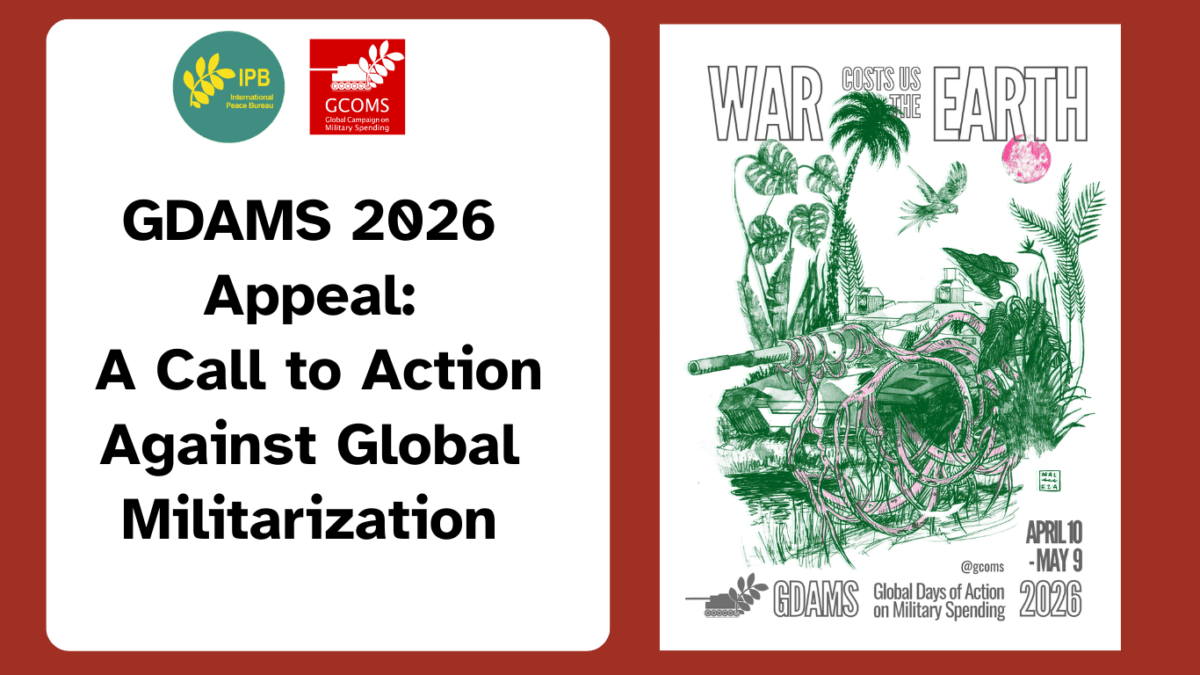
GDAMS 2026 Appeal · A Call to Action Against Global Militarization

The global security landscape has deteriorated massively in recent years: the number of wars and violent armed conflicts active today is the highest since the end of World War II, erupting across the world and drawing in an unprecedented number of states and actors. From Gaza and the West Bank, Sudan, and the Democratic Republic of Congo, to Ukraine, Venezuela, Iran, and beyond, levels of violence, civilian suffering, and violations of international law have reached heinous heights, including the commission of genocide.

Continue reading “GDAMS 2026 Appeal · A Call to Action Against Global Militarization”